Showing posts with label pokie machines. Show all posts

Wednesday, 28 January 2015

Recovery from Gambling Addiction: Lesson learnt from Silvia's experience #4 Be Cruel to Yourself


Be cruel to yourself! Yes? No? Manage to get your attention? :P

Be cruel to yourself means: to do something you don’t always do, which is to overcome that resistance to change. And when you overcome the resistance to change, change takes place and you will speed up your recovery process.

Because staying in gambling is easy, because escaping is easy, but to face the problems, you feel like it will take so much effort to get better right? It is true, because it takes you out of what you normally do, what you normally react, it takes you out of your comfort zone and sometimes you might feel vulnerable when you are facing these issues.

Actually, lesson #4 is about: now is the time to start taking care of yourself. And you have every reasons to be, so you can be in a position to win this fight against gambling and better recovery.

Especially if any one of your triggers is emotional, such as stress, anxiety, depression, boredom, seeking thrill etc.

I know gambling is an easy way out for many of us but… I want out, hence I am going to do things differently than letting myself go.

In an attempt to recover from gambling addiction, I looked through journal papers to see if I can change something to better myself and aid in recovery.

And it’s true enough, after I follow these steps, I have functioned better and having less emotional triggers that leads to gambling.


#4.1 Sleep well

First of all, please do have enough sleep about 7-8 hours of sleep a night and make sure you’re sleeping at night and not in the day.

The lack of sleep can lead to more cognitive/mental malfunction. Research had shown when you sleep, the cerebrospinal fluid flushes the metabolic waste out of your brain so your brain can function better after refresh. This is when the body can heal itself, through sleep.

Studies had also shown that the lack of sleep can lead to cognitive malfunction such as poorer judgement, poorer memory recall, and more impulsivity. People who are night owls or nocturnal are also more prone to mood disorders and mental illness. I used to be nocturnal and after reading papers on this, I changed my sleeping patterns, I will also highlight the importance of vitamin D, sleep and melatonin later at #4.3.

To get better, is to sleep better. It’s better for your brain anyway.


#4.2 Eat Well

Many mood disorders are brought about by the lack of nutrition and nutrients the body needs.

One of the trending topics in research world is about gut bacteria and you have millions and billions of it. Think of your gut microflora as something like a forest. Depending on what you eat, you populate more of some species than others. But not all species of gut bacteria are good for you. Studies had shown that people who eat irresponsibly and have more junk food in their diet (oily, fried food, nutrients-poor food) are related to having some form of mood disorders such as depression and anxiety. Studies had also shown people with depression had a gut bacteria population different to healthy normal control. These findings showed us that what you eat can affect your body and how your brain function and think.

Fibres, oh my goodness! Did you know to populate the good bacteria in your gut, you actually have to feed them good fibres from vegetables and fruits? I am convinced now after reading various papers, now constantly looking for ways to add veges and fruits to my diet.

Make sure you eat a well balance diet: good amount of carbohydrate and protein and low fat but not no fat, some amount of good fat is good for you. I remembered one time I traced back my sudden onset of depression due to me following the fad diet of high protein and low carb diet, it actually “crashed” my brain. I later learnt carbohydrates and proteins help your body to produce serotonin and dopamine in your system, they are your happy chemicals.

Eat at regular times, because your body wants to know when and where to consistently produce your happy chemicals and not wreck your reward system in your brain (which is often disturbed by prolong gambling).

Some studies had also shown that supplementing diet with omega-3 oil from fish or krill can have beneficial effects on the brain and help with depression and anxiety, this has to do with the ingredients in the fish oil (EPA, DHA).

Zinc deficiency had also implicated in mood disorder, nuts are good source of zinc.

Obesity can also lead to more mood disorders, so losing some weight will help.
The bottom line is eat well, eat right and you will feel better. Feeling better means better control, which leads to quitting gambling successfully, and sooner to recovery.


#4.3 Exercise Well + Sun

Sun exposure and exercise can be as simple as…

Oh please don’t frown at this, I know some of you will… You can start with 15 minutes of brisk walking that raises your heart beat. Do make sure you are in good physical condition to exercise otherwise please consult your doctor.

15-30 minutes of brisk walking (meaning walking with intensity or walking quickly). If you live around areas that have uphill slopes or roads with incline, you will benefit tremendously from this, it adds intensity. Walking casually is not exercise enough, to exercise sufficiently, you need to raise your heart beat with moderate intensity exercise, you can do so by brisk walking. Did I also mention I actually lost 3 kg by just brisk walking 35x2 minutes  a day to and fro my university. Simple exercise can bring about huge benefits.

In addition, exercise is a healthy source of happy chemicals (I cover what happy chemicals is from other lessons). In the journals papers I read, exercise helps with metabolism and can raise happy chemicals within your body, even those chemicals normally you lack of when you are depressed or emotionally unbalanced. I won’t go into tiny weeny details such as how exercise changes your circulating miRNA, proteins (which are stuffs my nerdy brain are interested in), just take my words that it will help you better your mood.

Vitamin D deficiency is often associated with mood disorders such as depression, panic attack and anxiety. To help raise your vitamin D, just go for a walk and expose to the sun for 15-20 minutes a day. You can also get vitamin D from some food such as milk or take supplement, but please take them in the day or you won’t be able to sleep at night.

Your body makes vitamin D after exposure to sun in the day and at night they inversely make melatonin which helps you sleep. See how going outdoor for a bit and having good sleep are important for your body system now?


#4.4 Think Well: Mind Gym / Mood Gym

Below are some online help suggestions for strengthening your mind. Some of us don’t grow up with the set of skills or being taught how to regulate our emotions and thinking. It can be our very own self-limiting belief that is bringing our mood down. Example: Oh my goodness this is SO stressful, I really have to go somewhere to relax and... end up where pokies machines are…”.
Instead of reacting to stressful/boring/anxious/depressing environment the same way as you always do, you can learn to re-route your train of thoughts by re-directing your brain how to think better. If driving the same path always ends up in traffic jam or accident, why don’t you try taking a different route then? You just need a GPS (some help for how to begin), and the you can find yourself with a new thinking pattern. Sometimes not new thinking pattern, you may just become so aware of your thoughts that now you will have more control on what to think and feel next.  If you find yourself needing more help, please find professionals to help you or email me with specific questions or areas.


Mindfullness meditation

#4.5 Quit well: Take note of other addictive behaviour (your other source of unhealthy form of happy chemicals)

Usually people with addictions have other co-existing addictive behaviour too. Do you notice that you may also smoke cigarettes or excessive drinking or addicted to food (sugar, caffeine, fat, etc) or video gaming, compulsive web-surfing or even physical interaction. Take note of these behaviours as you quit gambling, whether one becomes more or less obvious. If you slowly tune each of them down, you will have higher chance of quiting gambling successfully, instead of turning one addiction to the other.

I have sugar-addiction too but now it’s more tuned down :P


#4.6 Relax and Socialise. Re-connect with people.

Socialise – your other source of happy chemicals, re-balance your brain.

I know you may ask: how can you socialise and be happy when there is such a huge debt behind you? The truth is, if you continue to gamble, you will pile on more debt. Stop now, start anew and learn to re-balance your brain again with healthy good sources of happy chemicals. Of course please choose to be with the ones that make you happy and positive, not the ones who always complain about every single thing on earth that brings your mood down.

Because when you are comfortable, relax and have a great company, your brain naturally gives you a healthy boost of happy feel-good chemicals, which you don’t need the pokies or gambling to give you. It also allows your brain to re-calibrate your feel-good self.

I know some of you may be recluse like I used to and may encounter social anxiety while you do this. I think it is natural, after all you haven’t been meeting people for so long and suddenly you feel great connecting with your friends, neighbours or best mates, the surge in happy chemicals in your brain may leave you feeling empty and vague after you leave the group or company. Do it a few more times and you will get used to it.

I remembered I felt so good chatting with my mates again in-person, only to feel that huge drop after I finished meeting with them. Do I go back gambling after that? No, I simply just visualize and tell myself I will get used to this happy feeling again, each time I will feel more and more happy and after when I leave the meeting/catch ups, I notice the drop is getting less and less.

One of the factors that contribute to Happy People being happy is that they always have feel good connections with someone, friends or family, etc

One recent article also suggested that if you connect with others or environment in a positive, you are also likely to give up addictive behaviour. For more information see here: The Likely Cause of Addiction Has Been Discovered, and It Is Not What You Think

#4.7 De-stress and do something you like! Re-connect with your life and interests.

This is also to re-build your normal healthy happy chemicals pool. Pick something you like to do and go do it. Pick up that hobby again. In James May's toy story show, they made volunteers to help build huge Lego structures and some of them said it was therapeutic. Listening to your favourite songs can be also enjoyable.

Pick up meditation can help calm your mind and bring your stress level down.


#4.8 Overwriting triggers

Your Gambling-Free 100 days

If you are always counting gambling free days, example “this is the second day I haven’t gambled”. I always think that it may not be a good idea to always remind yourself of something negative, kinda reinforcing gambling as negative and sometimes the underlying fear may creep in the background and cause the relapse.

Instead, I proposed counting days of “instead of gambling I do this… and it makes me happy day” (or you can use the word calm, peaceful, life more exciting etc)

E.g. Day 1, Instead of gambling, I choose to go out with my friends, we laughed a lot and it makes me happy.

Day 2, Instead, I choose to play a computer game, never have so much fun until now, and it makes me happy

Day 3, Instead, I go to the Gym and work out, I feel healthier, and it makes me happy

Day 4, Instead of being bored, I choose to go to a live concert, listen to music, and it makes me happy

Few techniques applied here, 1) you don’t remind yourself again and again gambling has a negative influence on you; you don’t need to remind yourself you are quiting gambling, eventually you will successfully quit it. 2) Re-direct your brain to doing something you enjoy, so your brain knows there is alternative way of being happy, calm, peaceful and not bored. 3) Planned and looking forward to an event generates happy chemicals, helps you to cultivate that balance back. 4) Overwriting past triggers, e.g. it used to be when you’ve got nothing to do, you go to gamble. Now you can do this: Day 6, Instead of having nothing to do, I choose to plan a trip to my favourite café to drink coffee or weekend trip getaway, and it makes me happy.

Been planning to complete writing for so long. Sorry for the delay.

Please let me know if any of these information is helpful. Keep your emails coming, I enjoy reading them :)

For now, take care and good luck.

Till next time,

With many blessings,

Silvia

Wednesday, 9 July 2014

Recovery from Gambling Addiction: Lesson learnt from Silvia's experience #1: Your cravings might be a subconscious sign that your brain is telling you it need something to be done.

Your cravings might be a subconscious sign that your brain is telling you it need something to be done.

After reading Alan Carr's book on Easy Way to Stop Gambling, I believe, gambling created a "feel-good memory" in my brain. Or sometimes I referred to as "dopamine memory".

And every time when your brain is feeling low or not feeling calm (e.g. feeling anxious, panic attack, bored, overly high and happy, emotion fluctuations etc) , subconsciously this intent of wanting to feel good/normal again pops up. And what does your brain do? Your brain will do a scan and then subconsciously remind you that gambling will help to make you feel good again. How does the brain do it? For my case, it pop up an image of pokies machine and prompted me to go and "invest" again...

And after prolong period of not gambling (a few months), and every time I wanted to feel good again, unintentionally, I started eating a lot sugary food or favourite snacks or hunting for that specialty coffee (I love coffee!). One day I began to realise that, whenever I procrastinate or didn't want to do a certain task at work, I find myself craving my favourite snacks or have a strong desire to look for a good place to have a good cup of coffee.  My brain no longer tells me to gamble.... it signals to me of another thing that will make me "feel good" again. So somehow, my brain overwrites the previously "feel good" signal (from gambling) with another (eating favourite things). Warning: I do not promote emotional eating ;)

This overwriting doesn't happen overnight, it happen over a long time of "re-conditioning". The issue is, the "feel good" signal derived from compulsive gambling is so enormous that it is often hard to overwrite. Think of it as a happy chemical in your brain, gambling generate a lot of it with high intensity that is usually hard to match up, especially the way the pokies machines are designed (the sounds, the routine, the payout, the increasing number of credits you see on the screen... everything is ingrained in your brain). I especially remembered once I was going to gym and feeling great after workout, only to realise the "feel good" wasn't in the same magnitude from the ones generated from gambling. Look, my brain made the comparisons! What pokies machines and gambling do to my brain is evil!

So, how did I manage to overwrite the urge to gamble, or the subconscious signal that used to pop up whenever?

First: Abstinence. Stay away from gambling. We have to desensitize the "feel good" signals that gambling brings.

I would say anything to do with gambling. It is never about the $20 ("let's just gamble $20 only" sounds familiar?) because I did that and I ended up loosing all my savings from chasing loses and racked up credit card bills after one trip back to pokies machine. Also refrain from doing anything to do with game of chance and anticipation such as lottery purchasing. It is like you packed away gambling in the Pandora box and only to opened a bit of it to again, and it is never about opening a slit to peep, you end up opening the whole box all over again. What I mean is, after a prolong abstinence from gambling, I thought it was ok to buy lottery again. As I analysed it, you kind of can "control" how much you loose and the rate of loosing seemed slower (gambling away $1000 at pokies machine in 1 hour versus buying $20 worth of lottery tickets). But no, once I started buying lottery, I ended up going to one of the pubs VIP lounge and gamble ALL my money away. It is as if I told my brain from my actions that it is ok to gamble again and then my brain let loose. That's why I said, to desensitize, best is to stay away.

Two: Never suppress your urges, let it come and go.

As time goes by, the urge or craving will become lesser and lesser. I used to walked past VIP lounges at the pubs with my brain signalling me to go in to gamble. EVERYONE of them EVERY SINGLE TIME. It is as if my brain has a regional memory,  it is like saying "hey that's a place to feel good again, let's go in". My brain did it so naturally, and the problem with Australia is, except Perth, almost every pubs and bistro have pokies machine, walking down a street full VIP lounges, it is almost difficult to say no! One weak thought and you might just give in. But not anymore after you read this, it will bring you more awareness. Notice what triggers your cravings, is it you not having enough money and wanted money the quick way? (I did) Or just walking past VIP lounges is enough to trigger the thought of gambling.

What happens when you suppress your urges? It only gets worst and crave more. Think when you were a kid, if you love sweets and someone tells you, you can't have it, won't you want it even more? I started realising this when I tried not to think about gambling and every time I think about it I also attached a fear to it, I was worried I will never have savings because every time I am in the "positive" in the bank, meaning I have savings, I fear that I will loose it all by giving in to pokies machine. I also fear that I will never be gambling free and problem gambling will haunt me the rest of my life. The more I fear, the more I gamble. It appears to me every time I remind myself with fear, my brain will think of gambling. This is as if my brain is in a "not feeling well" position and then telling me "hey, the last time you gamble, you felt good, why not go back there and bring yourself up again". My brain remembers the closest, most effective way to "feel good" activity.

Upon realising that, I stop worrying and fearing, whether about my debts or I will gamble again, I just stop fearing, simple as that. There is no point beating yourself what had happened, it is better to focus from here onwards, what can be done to move forward. This is also a re-direction of your brain, and to refocus your brain on better subjects.

Three: Find a new feel good signal.

Everybody is different, for me is eating my favourite food and café hopping. I will say this is the most difficult part, because the "feel good" signal generated by gambling, especially from pokies machine, is so great that it may feel almost impossible to overwrite. It is like me, after gambling at $5 per maximum lines per spin on the pokies machine, and to go back to just gambling 30 cents per spin, I don't feel the same anymore. The "high" is different gambling at $5 per spin and at 30cents per spin, the rate at which the credits multiply is drastically different too, visually.

But surely and slowly you can re-train your brain to like something better, something that makes you feel so good that eventually over-write the poor gambling habit. Start with something you like, redirect your brain that something else can make you feel good too. Be patient. Expect failures, it could be hard to overwrite, BUT IT CAN BE overwrite. If you do enough, and many times over and over again, and when you start desensitise your brain from not gambling, your brain will start reminding you how to get the new "feel good" emotions. Nowadays, when I walked past VIP lounges, my brain no longer remind me automatically to go in to gamble. In fact I often did not realise I have just walked past a VIP lounge, it is different from last time where every time I walked past one, my brain never ceased to remind me of pokies machines inside the venue.

I also have to warn, be careful to what you overwrite your gambling addiction with, it is usually with another forms of "addiction" or "happy chemical/dopamine generating activities" (could be exercise, smoking, eating, sugar etc), just make sure it is healthy! Yes, I know sugar is now my favourite cravings, it is better than loosing money through gambling, plus because I am also quite healthy conscious, my brain does moderate my intake so all is well ;)

You can do it! You can feel good again without gambling! You have to start feeling good without it!

To overcome gambling addiction, there are more layers to it, I will uncover the other layers and road to gambling free life in my upcoming posts.

Stay well~

Till next time,
Love Silvia

P.S. found this article online: http://www.scientificamerican.com/article/how-the-brain-gets-addicted-to-gambling/

It confirms what I believe ;)

Friday, 20 June 2014

Recent update

Hi all,

I am sorry I have yet to update my blog due to busy schedule. I will try and post more in the near future. Good news is I haven't been gambling for a long time. I don't count the days I am out without gambling because I am focusing my mind on other greater things in life rather than being constantly reminding myself on the topics of gambling.

I will update on how and where to get help, some techniques which are backed up by science to help cope with gambling problems, and how to retrain your brain and overwrite that craving and beat pokies and other games. :)

stay tune.

with love,
Silvia

Monday, 24 February 2014

Epiphany! Interesting Read on Allen Carr's book

While I was desperately seeking help online one day, a kind man dropped me an email and asked me why not check out Allen Carr's book on Easy Way to Stop Gambling. It helped him quit.

I said to myself why not.

And then an epiphany came to me when I finished his book, or even when I was half way through the book.

This is what I have gathered from all information I have digested from various sources including reading Allen Carr's book.

Allen Carr said in his book on Easy way to quit smoking "Each cigarette does nothing more than make them feel how a non-smoker feels all the time". Perhaps gambling also does nothing more than make people feel how a non-gambler feels all the time.

Now with my understanding, gambling created a "feel-good memory" in my brain. Or sometimes I referred to as "dopamine memory".

When I feel low, for example when I feel depressed or feeling inadequate, there seems like a general anxiety that breeds inside me and I dreaded that feeling. My brain then remembered how to make myself feel good again. And exactly this feeling often leads me to enter a gambling venue such as a pub or bistro nearby and started putting money into the pokie machine. As soon as I sat down and play, my focus shifted, instead of feeling low, I began to focus on the machine, the reels the lines and the sounds, almost naturally the pokie machine take my mind somewhere else. And it never occurs to me that this is when I feel "normal" again. I maybe numbed and hypnotized in the moment, but I "FEEL normal", not sad, not low, but normal, like I am back to my "baseline" or even better, because of winning and hitting the features etc.

Of course when you loose all your money, you wanted to "feel good" again, and the cycle continues. This is also why people chase loses or even when winning or loosing enough, they would not leave. They felt compelled to stay until they have no money left to put in the machine. They want to feel good all the time and avoid feeling the nasties! Even you don't feel good emotionally, your brain chemicals speak differently, it tells your body you feel good from gambling because it registered it as a "happy-chemical memory".

My boyfriend used to think that because I was depressed and therefore I gambled. This was not true because I realized that I too gambled when I was feeling happy too. This greatly surprised me.

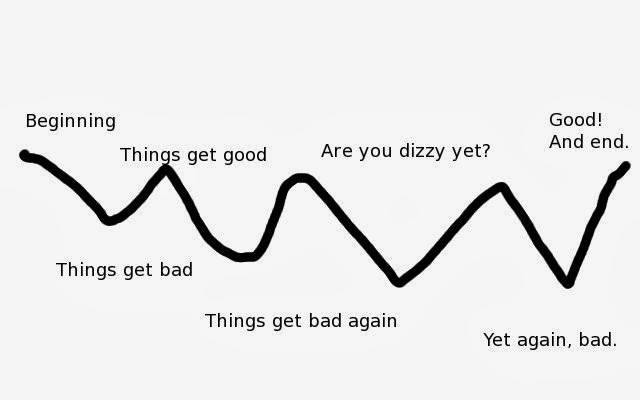
However, the same principle mentioned above was able to explain this. I was feeling high and therefore there was some nervous energies high above my "baseline" that I was subconsciously trying to "contain" or regulate. My brain of course remember gambling as one of the habit or event that my mind can stay running like a horizontal line on a graph


Instead of this:


Because the pokie machine are like so hypnotic with their sounds, the visual, the symbols, the features etc... It is no wonder we all feel different when we are gambling than when we are not. We may feel better, more "balanced", void of our life issues because at that moment we don't need to think about any problems and just concentrate on the lines and reels and the credits return. The ups and downs caused by life problems, debts, not having enough money were thrown out of the window when we gambled and were replaced by little peaks of the heart skipping a beat when you hit the jackpot or the free game feature.

SO NOW THAT YOU HAVE LEARNT why we "feel good" while we are gambling and your needing to "feel good and balanced". And gambling serves no purpose other than making you feel "normal" again, or even worst, put you in debt when you have no money for food and living and even buying what you want and need.

I hope you have an epiphany like I do and start finding other ways to balance your brain to feel good in other ways instead of gambling. It is not going to be easy, because the stimulus brought about by gambling is so huge, but you really have to make an effort. It takes time and never stop trying.

I also happen to change upon this document explaining the happy chemicals.
Happy Chemicals Explained

Till I write again, All the best.

First Step to Recovery is Acceptance... Not Suppression...

The first step to recovery is acceptance. This is what I have learnt.

Why? Because from experience, usually after a heavy lost, I vowed not to gamble again. And each day I was in abstinence there was always this fear breeding inside me, the fear that one day I would relapse again... and almost like a self-fulfilling prophecy, I did.

I learnt that each time I tried to suppress the thought of gambling, it will somehow make the urge to gamble stronger. It's almost like asking someone not to think of pink elephant and they inevitably will.

Noticing this, I stopped suppressing the thoughts of gambling and along the fears that I would relapse. Instead I allow my thoughts to come naturally to me knowing that they will eventually pass. I choose to face my fears. I accept as they come and choose not to react to them.

As a result, I notice a strong reduction in urge to gamble.

Therefore I never count the days I am gambling free, I spent my energies and time working on doing "mind gym" and building a stronger mind to prepare myself if one day I am vulnerable again, my mind will be strong enough to find a way out.

I know for some of you, calculating the days you're gambling free helps and encourages you, just keep doing whatever that helps you.

Bottom line is... recovery starts with acceptance, accept that you have a gambling problem, you're a compulsive gambler, having an addiction problem and face your fears, it's a good start.


My Experience After Attending The Gambling Treatment Clinic

After sunking to the rock bottom, I decided to reach out and seek help. I research online and found out in Sydney Australia, there is a Gambling Treatment Clinic held at University of Sydney.

I attended one session a week for a period of 4-6 weeks. (I can't remember how long, sorry.)

I concluded that the sessions were helpful.

They helped me identify how I held false belief about the pokie machines. Even though I knew the machines operated at random, I believed that some machines were "more favourable" than others because they "were better aligned" hence greater chance of getting a better return.

They also pointed out how much money I would have lost in total and helped me to trace back what happened in the past that trigger the gambling problem.

They informed me that the gambling problem is a  "learnt behaviour" and can therefore be "unlearnt"

They told me that pokie machine were set to return about 75-85% of the credits bet and how this is done. This was actually the first time I learnt about this rule. They shown me how even though machines operate randomly are set to return 75-85% of your credits bet, you will still end up loosing in the long run if you continue to bet and the house always have the "house edge".

One important message that come out of the sessions, "Winning is only temporary so, what's the point?"

The treatment sessions and counselling were helpful. Therefore I encourage you to reach out and seek help.

I can't say that the completely cure me and stop me from compulsive gambling, but I would say they do help to a certain extend in pointing out and straightening up some of my false beliefs. I did gamble a lot less often or rarely after. Every bit helps. I know I still have problems and I will touch on these problems some other time.


Updated: 14 July 2014

Found this article online: http://www.scientificamerican.com/article/how-the-brain-gets-addicted-to-gambling/

It confirms what I believe ;) That gambling problem is an addiction, though my therapist said that it wasn't and it was a "learnt behaviour". Pathological gambling was used to be classified as impulse control disorder in the Diagnostic and Statistical Manual of Mental Disorders (DSM) and now moved to a more appropriate category: addiction.

Sunday, 23 February 2014

If Rats Are Susceptible... So Can You! The Near-Miss Effect...

I am 34 years old female a phD student, a researcher and having problems with pokie machines. It just go to show anyone is susceptible, female or male, irregardless of your occupation, your financial status and intelligence...If even rats are susceptible, so can you!

Sometimes I read widely, and anything that interests me. 

In an attempt to understand my compulsive gambling behaviour, I came across a journal articles titled "A Selective Role for Dopamine D4 Receptors in Modulating Reward Expectancy in a Rodent Slot Machine Task." Wow, they had even designed a slot machine for the rats!

"Methods: In the 16-month study, a cohort of 32 laboratory rats responded to a series of three flashing lights before choosing between two levers. One combination of lights (all lights illuminated) signaled a win and seven combinations (zero, one or two lights) signaled a loss. A “cash-out” lever rewarded the rat with 10 sugar pellets on winning trials, but gave a 10-second “time out” penalty on losing trails. The “roll again” lever allowed the rats to begin a new trial without penalty, but provided no sugar pellets.

Interestingly, the rats showed a tendency towards choosing the cash-out lever when two lights (near-miss) illuminated, suggesting that rats, like people, are susceptible to the near-miss effect."

Which one of you, like me, are susceptible to this near miss effect? I hadn't given too much thought about the near-miss effect until I read this article. The sounds the coins of the "Five dragon" pokie machine makes when they landed on the reel and the lanterns on the Lucky 88? 

It makes sense now, I was always rooting for the "free game" features and get very very excited whenever two of the scatters landed on the reel to almost hit the feature. I could feel my heart beating fast or almost skipped a beat! 

And many times the reason why I won't leave even when I was winning or loosing is because "something tells me, a free game feature is near..." "I will stay until I hit the next free game feature!"

All the visual and audio ques the pokie machine makes, is ingrained in the brain, like a form of hypnosis. Hitting the feature or almost hitting the feature must have create something in my brain that makes me feel good and wanting more. I started to call this "dopamine memory" or the "feel good memory" after I read about the effects of what dopamine and serotonin do to you. I will write on this topic sometime later.

So, the next time you're stuck at the venue again and rooting for a "free game feature" and seeing 1 symbol away from hitting the feature, think twice again... 

It's not you, it's the nature of the design of these pokies machines, they create something in your brain to make you crave more and more of those "feel good feelings"

And when you're loosing, you want these "feel good feelings" even more and ended up chasing loses and the cycle continues...

Some people are lucky to walk away, some not so lucky and have susceptible mind like mine, must learn a way to re-program our mind to cope with situations like this, learning other techniques to make ourselves feel good when we needed instead of hitting the machines straight away. 

Till next time I write again. All the best.

Gambling: Anyone is susceptible... About Me

I am 34 years old female a phD student, a researcher and having problems with pokie machines. It just go to show anyone is susceptible, female or male, irregardless of your occupation, your financial status and intelligence...

I had been playing pokie machine since 2002, where casino is so readily accessible in Australia. At first it was just me and my ex-boyfriend going there for a nice evening meal. They had $10 dinner deals where they give you a dinner meal and a $5 pokie machines voucher, so dinner only end up costing $5. Pretty cheap and easy for us student at that time.

We went in and have fun. It started $20 harmless fun. If we win close to $50, that night was amazing. Harmless fun huh?

Fast forward a few years later, I broke up with my then ex-boyfriend, sunk into depression and lonely. Where did I go? I went to casino in the city, where I could hide myself at a corner and just aimlessly, mindlessly pressing buttons away. It doesn't even matter if I win or lose money. I just wanted it to take all the "bad feelings" away from me. The jackpot link sometimes excited me.

I don't know when, but sometime in 2004, other life crisis happen (relationship was not going well and so was my studies) and along came a lot of life uncertainties. I started increasing my bets and numbing my sorrows in casino. I did not knew I had problem at that time except I was living paycheck to paycheck. If I ran out of money, I knew money will come in next month...

I started with 1 credit, 25-30 cents per spin to $8.40 per spin now. Lower credit bet lines does not satisfy me anymore, not the way they increase and multiply in credits paid as oppose to when I bet maximum each spins. So my advice is stop while you can before becoming like me increasing your bets each time.

Sometimes on a bad binge, I end up loosing all money I could access to in my bank which is $2,500 from my credit cards.

I had been to therapies and read books about how to tackle gambling problems.

Specifically, I had attended gambling treatment clinic at University of Sydney, hypnotherapy to help me cope with my problem gambling in an attempt to quit, read a few books on how to prevent relapse etc. Because I am a student, though I am not a pyschology student, I have access to journal articles and reading and researching topics related to compulsive gambling, OCD and impulsivity helps me understand more about the disorder.

I had been wanting to blog for a long while now and had a list of items I wanted to write on... so stay tune and check out often. :)

I can be reached at silvialining @ gmail dot com

First Post

Today mark the first day I am blogging about my recovery from addictions to pokies machine.

I had lost $3000 yesterday in a very bad binge on pokies machine yesterday. Yesterday is also the day where I finally have positive surplus $400 in my bank after it took me 4 months to repay the $2500 debt I withdrew from my credit card. Only today to start over again...

I really wish there is a way I could hijack my brain to make it better, overcome the intrusive thoughts to push me towards going back to the gambling venues and stopping myself from withdrawing frantically in huge amounts after severe loss. I know I can get better and stop gambling for myself, my family and my love ones.

I will not stop trying until I succeed.